Women Data Insights:
Civic Hacking for Change.
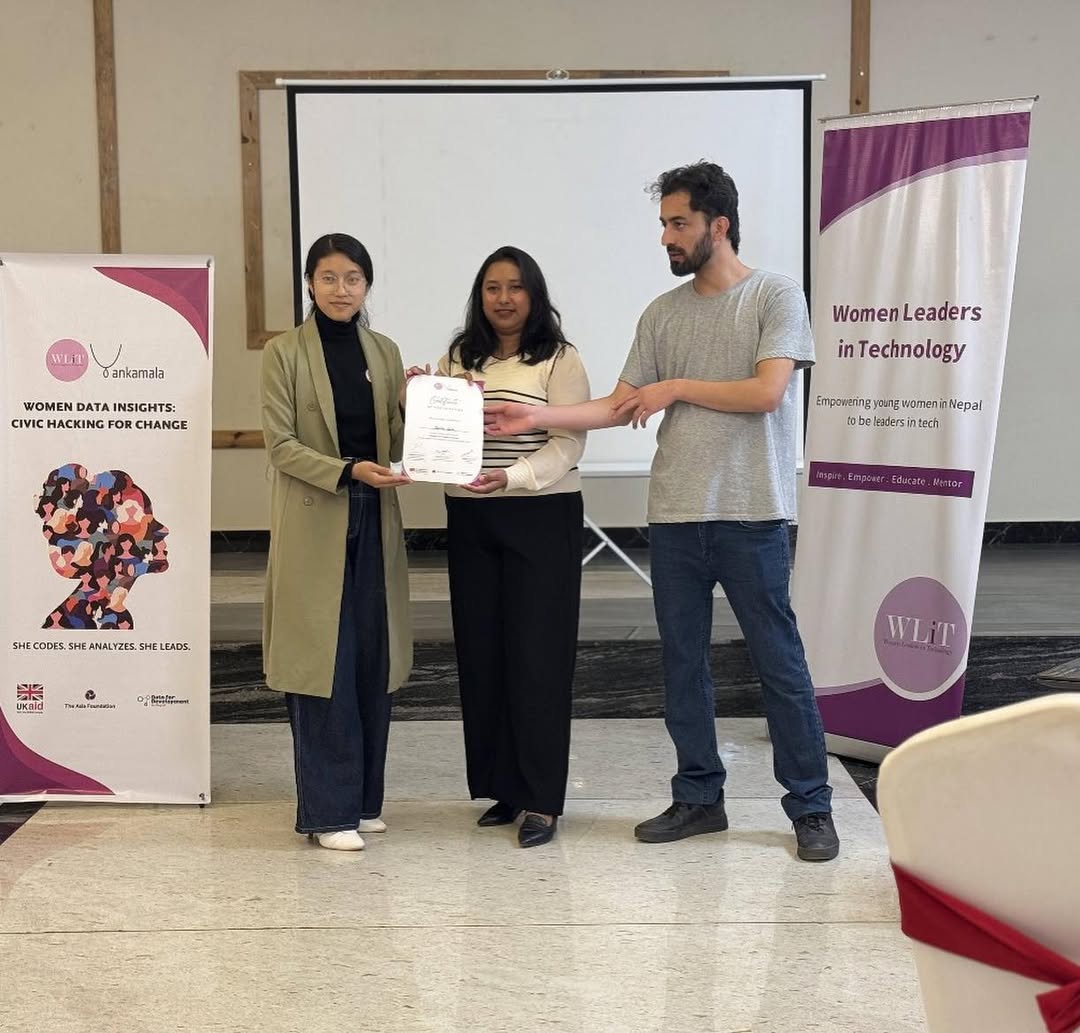
In partnership with Ankamala and supported by the Data for All grants for Women in Data Steering Committee, WLiT co-organised Women Data Insights: Civic Hacking for Change in November–December 2024 across Tilottama (Lumbini Province) and Surkhet (Karnali Province). The program engaged 63 participants from technical and non-technical backgrounds, with four projects selected from the hackathon delivering outputs as research articles.
Active Participants
Technical students and non-tech professionals collaborating in cross-domain units
Regional Hubs
Trained & Organised in Tilottama (Lumbini Province) & Surkhet (Karnali Province)
Research Articles
Hackathon project outputs selected to be fully published as formal research artifacts
Grant Support
Backed by the Women in Data Steering Committee
Cross-disciplinary teams structuring datasets and building visual analytics dashboards to highlight infrastructure gaps.
Democratizing Data Pattern Intelligence
The program introduces students and working professionals to the basics of data visualization. It shows how structured datasets encountered in daily jobs or found in public portals can be used to isolate local development patterns.
By connecting structural data processing to actual civic hacking models, the initiative translates raw statistics into actionable items. This teaches participants the basics of high-volume data analytics and supports proof-of-concept projects that address local equity challenges.
Participant Profiles
Non-Tech Professionals
Domain specialists who manage sector data in their regular roles and require stronger analytical validation pipelines.
Tech Students
Undergraduates and engineers eager to pick up production-grade workflows in big data cleanup, processing, and predictive UI dashboards.
Core Learning Outcomes
Data Cleaning & Structural Profiling
Mastering the ability to audit raw, disorganized datasets, map schema columns, identify formatting errors, and rebuild databases according to strict data profiling requirements.
Advanced Excel Engine Manipulation
Using analytical logic pipelines inside spreadsheets to merge records, map multi-dimensional arrays, deploy complex formulas, and reshape data for business intelligence tools.
Enterprise Power BI Visualization
Navigating Power Query Editor UI paths to handle table relations, unpivot records, transform data types, and deploy highly optimized visual metric boards.
Curriculum Breakdown
A comprehensive technical overview of tools, environments, and formulas taught throughout the track:
Data Diagnostics
- ▪ Structural evaluation of raw source datasets, column mechanics, and relationship matrices.
- ▪ Mapping out multi-dimensional databases to display structured records clearly across complex scenarios.
Excel Engines
- ▪ Executing deep database profiling to discover and correct missing entries or logical errors.
- ▪ Applying precision filter and replacement runs to refine datasets for clean visualization.
- ▪ Merging disparate records and using complex formulas to compress raw rows into formats optimized for Power BI import.
Power BI Analytics
- ▪ Mastering the layout settings, workspace dashboards, and data connector systems of Power BI.
- ▪ Leveraging Power Query Editor to manage column groups, filter parameters, and structural duplications.
- ▪ Pivoting and unpivoting complex matrices into clear single-dimensional tracks.
- ▪ Navigating model, report, and table view interfaces to adjust axes, scales, and fonts.
- ▪ Extracting logical patterns from charts to compile concrete, data-backed development strategies.
Civic Hacking for Change
The program wrapped up with a fast-paced civic hackathon challenge. Rather than producing throwaway code models, four select student projects yielded deep outputs that were curated and published as formal research articles, providing long-term value to regional policy makers.